Showing posts with label zombies. Show all posts

Friday, August 15, 2014

6 Degrees of Separation: Gone Girl

Today was the first time I heard about the '6 degrees of separation' meme hosted by Annabel and Emma. I've been looking for some content to help fill my weeks now that the HTBAG readalong is over and this seemed like a fun challenge. The rules are pretty simple too.


So here we go!


Gone Girl was fine. I found myself quite wrapped up in the story as I read it, but the more time that passes the less I think it was really anything substantial. Be that as it may, it's memorable for many things. The relationship between the married couple, the dark twists that abound the narrative and the absolutely horrendous people that populate the cast.

Horrendous people? Surely you're talking about the cast of Jonathan Franzen's The Corrections! I had a brilliant time reading this book with a group of bloggers last year, but ye gods were the people awful. Awful yes, but at least they weren't alone in their awfulness. The family that destroys-your-will-for-life together, stays together.

A better, although no less sinister, family are the sisters (and their poor uncle) in Shirley Jackson's novella We Have Always Lived In The Castle. For two young women they've been through a lot and are well acquainted with the flurry of emotions that follow the death of a family member(s).

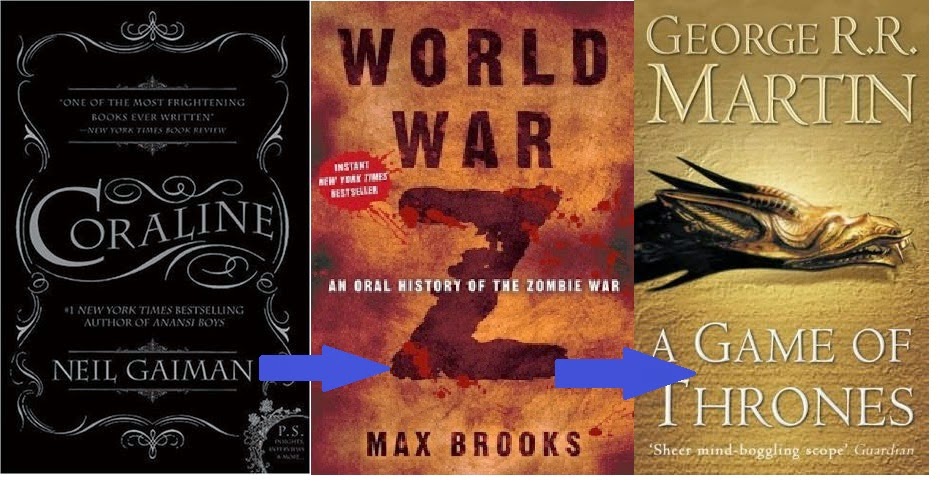
The house in We Have Always Lived In The Castle plays an important role in the narrative. Similarly, the house is Neil Gaiman's novel Coraline has its own special place between the pages. It is rife with magic and hidden passages and old and evil things and presents our Coraline with a novel worth of adventures and scares.

A few years ago Coraline was turned into a cracking good film, and after a couple of years of production delays and arguments between lead actors and directors, World War Z finally made it to the big screen to generally good reviews. The film had nothing on the book though, which managed to tell a terrifying and emotionally charged story about a world succumbing to the onslaught of undead villains. Perhaps the defining feature was the collection of short eye witness accounts that make up the novel. It's these differing perspectives, those of politicians and generals and filmmakers and doctors, that adds a level of humanity to the story that's often absent in zombie and end of world stories.

And finally, also utilising the multiple narrator format is George R. R. Martin's A Game of Thrones. Switching between different lead characters found in various parts of warring Westeros, this series manages to tell dozens of different stories within the larger patchwork narrative.


Wednesday, October 2, 2013

Book Review: Warm Bodies by Isaac Marion

Warm Bodies

Written by: Isaac Marion

Published: 2010

Synopsis: 'R' is a zombie. He has no name, no memories and no pulse, but he has dreams. He is a little different from his fellow Dead.

Amongst the ruins of an abandoned city, R meets a girl. Her name is Julie and she is the opposite of everything he knows - warm and bright and very much alive, she is a blast of colour in a dreary grey landscape. For reasons he can't understand, R chooses to save Julie instead of eating her, and a tense yet strangely tender relationship begins.

This has never happened before. It breaks the rules and defies logic, but R is no longer content with life in the grave. He wants to breathe again, he wants to live, and Julie wants to help him. But their grim, rotting world won't be changed without a fight...

Challenges: RIP VIII
_________________________________________________________________________________________________

"Once you've arrived at the end of the world, it hardly matters what route you took"

So it seems like 2013 is the year of YA reads. It's also the year of swallowing my pride and admitting maybe I was a little quick to judge. When I first heard rumblings of Warm Bodies online a year or so ago, I grumbled to myself about zombies finally being given the Twilight treatment. When favourable reviews started to come out I attributed it to people not really knowing the zombie genre too well, and therefore having pretty minimal expectations. In fact, I just went back to Alley's review (which is brilliant by the way, go read it and give her some love) and I commented saying:
I have this on my 'to read' list but it's definitely going to be a library book, because I still feel like it's going to be a universal joke to make me read a zombie Twilight story.
I was ready to write this one off without giving it a real chance. And considering I've been studying zombies for the past 2.5 years and have been burnt by shitty representations of zombies in literature in the past - I think I had a right to be a little wary. But when my PhD supervisor told me the film was actually pretty brilliant I had to reconsider my stance, because if Australia's best known and respected horror expert thinks it's a nifty take on the genre then maybe there's something to it. He was right, you all were, and I was very, very wrong. Warm Bodies is everything everyone said it was, it was funny and clever and a really solid YA read. It wasn't perfect, and I'll get to that later, but i'm definitely glad everyone wore me down and it was sitting on the "HEY! Read this immediately" shelf at the library.

So a lot of the reviews I've read have said "this isn't like any zombie story you've ever seen before" and that isn't entirely correct. Isaac Marion, who surely must be a pretty big fan of the genre, actually builds on the work of George A Romero. Romero's best known for the first two of his six zombie films, but if you follow the two trilogies there's a clear evolutionary path that the zombie takes. From mindless cannibalism and the reckless spread of their virus (Night of the Living Dead), the zombies slowly start to show recognition of household items (Bub and the telephone in Day of the Dead), to organised attacks against human oppressors (Big Daddy in Land of the Dead), to choosing to eat animals over humans (Survival of the Living Dead). What is new, however, is taking this idea and showing it to us from the zombie point of view. Whether Marion actually intended to build on Romero's work is up for debate (I can't honestly be bothered to see if he's said anything to this effect in an interview), it's clear he needed to take this approach to make the story work, because a story from a traditional zombie's point of view would be terribly boring. But Marion manages the difficult task of balancing this idea of consciousness with well-known zombie conventions. It's true that they think and maintain relationships and families, but they do still attack and eat the living, rot and decompose and can be taken out completely by a blow to the brain. It advances and adapts the genre without slapping die-hard fans in the face - something that Stephenie Meyer never managed to get a hang of.

I intend to throw Twilight under the bus A LOT more
I'm sure you've all heard the basic breakdown of the story, but here's a refresher just in case. Warm Bodies is based on Romeo and Juliet, although beyond the forbidden love angle and a scene on a balcony, it's a pretty loose adaptation. Did it actually need to be based on one of Shakespeare's most famous plays? No, but unlike Twilight it's not just a ham-fisted shout-out screaming "LOOK IT'S JUST LIKE GREAT LITERATURE". Romeo, or R in this case since he can't remember the rest of his name, is different to the other zombies. He seems to have retained more of his humanity and is constantly battling with the existential crisis that is life as a zombie. He goes through the motions, he kills and eats the living, "marries" another zombie and adopts a couple of kids,  rides an escalator around and around - but it never seems like enough. And then one day on a hunt he finds himself drawn to protecting a human, a girl named Julie. He covers her in blood, pretends he turned her into one of them, and takes her back to his home in an aeroplane.

And this is where my favourite part of the novel comes in. The reason R falls for Julie is that he eats her boyfriend. And in Marion's world, when a zombie eats a brain they get a brief flash of the life that their victim lived. Some flashes are stronger than others, and R seems to live (ha! sorry not sorry) for these brief reminders of life. So when he takes a bite of Perry's grey matter he experiences a flash far greater than he's ever experienced, and Perry's love of Julie is passed on to R. It's this initial flash of life and emotion that leads to the development of our two leads' relationship and the unfolding of the narrative. R becomes almost addicted to revisiting Perry's life (he keeps the rest of his brain in his pocket for snacks) and eventually it develops into something...more. And the small flashes of Perry's life and his struggle to find a reason to live in a post-everything, zombie-infested world were brilliant. It's not that R and Julie were bad characters per say, but they are both cut from well-worn YA cloth and didn't really deliver anything new. Perry on the other hand felt more human and less like an archetype, and I shared R's curiosity in unfolding the story of his life.

The zombie life mirrors the life of the living in Warm Bodies. Both groups have banded together into larger groups for protection, they train their young to survive in this apocalyptic world, and they struggle to retain a semblence of pre-zombie normality. There's not a lot of cheer and optimism in the living camps, but there's even less in the zombie hives. They live in groups, but given their inability to truly communicate or physically respond, they're always alone.
"We recognise civilisation - buildings, cars, a general overview -but we have no personal role in it. No history"
Their hunger isn't something they have any control over, and R isn't the only one who seems to detest what they've become. All of their attempts at living life, their marriages, attempts to have sex and fascination with eating brains are so sad and empty that it's hard not to feel sympathy for these people who were once us. And Marion manages to weave these small moments of levity into the greater romance plot in such a way that it never feels overly sad or philosophical, but it's impossible to completely ignore them.

Mild spoilers - Although I liked the book overall, I actually didn't love the central premise, namely that through meeting Julie R begins to transform. The execution felt a little rushed and it was a little overwrought and under-explained. I think it could have been a fascinating book if they had to learn to love and live with each other despite their differences, differences which are impossible to ignore. I understand that Marion is writing a sequel which perhaps will explore the cause of his transformation and the ramifications, and certain hints regarding the boneys give a cursory explanation but I wanted more about the how and why and less about the R&J love story. But then I'm pretty stone-hearted when it comes to YA romance stories. End spoilers.

I don't particularly like being wrong, but when it comes to a book exceeding expectations I'll happily accept it. Warm Bodies is a funny and sweet novel that I'm starting to think might actually be my new favourite zombie novel. And in case you're nervous about it being scary (it isn't) because zombies are always scary (seriously it isn't scary) you can actually read the short story that this was based on, which will 100% prove to you that I'm not lying about it being non-scary.




Friday, August 16, 2013

Book Review: World War Z by Max Brooks

World War Z

Written by: Max brooks

Published: 2006

Synopsis: The Zombie War came unthinkably close to eradicating humanity. Max Brooks, driven by the urgency of preserving the acid-etched first-hand experiences of the survivors from those apocalyptic years, traveled across the United States of America and throughout the world, from decimated cities that once teemed with upwards of thirty million souls to the most remote and inhospitable areas of the planet. He recorded the testimony of men, women, and sometimes children who came face-to-face with the living, or at least the undead, hell of that dreadful time. World War Z is the result. Never before have we had access to a document that so powerfully conveys the depth of fear and horror, and also the ineradicable spirit of resistance, that gripped human society through the plague years.

Ranging from the now infamous village of New Dachang in the United Federation of China, where the epidemiological trail began with the twelve-year-old Patient Zero, to the unnamed northern forests where untold numbers sought a terrible and temporary refuge in the cold, to the United States of Southern Africa, where the Redeker Plan provided hope for humanity at an unspeakable price, to the west-of-the-Rockies redoubt where the North American tide finally started to turn, this invaluable chronicle reflects the full scope and duration of the Zombie War.
____________________________________________________________________________________________________

"Ignorance was the real enemy, and cold, hard facts were the weapons"

So remember in my WWZ film review when I said;
Zombies don't sell. What sells is the story that the zombies facilitate, a story about people surviving, solving problems, dealing with their shit and looking badass while they do it.
This is that story. And even though there are probably a few (*ahem* a lot *ahem*) of you going "yeah but no, zombies blechhh", this is still one of those books that I suggest to everyone. Because it isn't about the zombies, they factor in of course and there are definitely some tense and scary scenes, but it's really about how the world survives an attack of proportions we'd never imagined possible. And it's brilliant, like really truly undeniably brilliant.

Over the course of 8 sections (Warnings, The Great Panic, Around the World and Above etc), Brooks tells the story from the early days of the infection to the final fights to take back our planet. Each section is made up of a series of recollections, eye witness accounts from  doctors and scientists, generals and soldiers, politicians and filmmakers, conscripts and families. People who were there, were integral to the events, and who have their own personal story to tell. But best of all, this story is universal. It's not just told from the American perspective (although a large portion of it is), you read accounts from people in China, Australia, Cuba, Canada, India, Iran and Israel, and you get to see how each country reacts to the threat and deals with the aftermath. The result is a rich and complex story.

Brooks clearly did a great deal of research about the politics, culture and history of each country in WWZ, and so the unfolding of each story reflects the characteristics which make up that country's national identity. North Korea, unsurprisingly, disappears off the map completely. Cuba's lengthy history of civil tension and difficult relations with America becomes a strength when faced with the zombie threat and the influx of American immigrants escaping the zombie-infested US. Parts of Europe returned to the middle ages, choosing ancient battle weapons and the safety of castles over modern technology. And America's recent involvement in a different war weighs heavily on the political and social reaction to the early zombie reports.

The result is a very realistic story. When you hear that Russia returned to a theocracy and is using the weakness of the rest of the world to try and return themselves to their former strength you don't blink twice. When you read that Israel was one of the first to accept the early reports and initialise a self-quarantine, and that the reasoning is that their past made them cautious and unlikely to discount any report no matter how unlikely, you can accept it. Everything is connected to actual historical events and cultural perspectives, so you can't help but wonder whether that's actually how it would happen if we woke up to an influx of zombies tomorrow.

This carries over into the human interest side of the story as well. From the way the zombie infection likely spread from the first reported case in China;
 "China used to be the largest exporter of human organs on the world market. Who knows how many infected corneas, infected pituitary glands...Mother of god, who knows how many infected kidneys they pumped into the global market. And that's just the organs! You want to talk about the "donated" eggs from political prisoners, the sperm, the blood? You think immigration was the only way the infection swept the planet? Not all the initial outbreaks were Chinese nationals."

To the role politicians and public figures, such as the English royal family, played in encouraging hope;
 "They were viewed very much like castles, I suppose: as crumbling, obsolete relics, with no real modern function other than as tourist attractions. But when the skies darkened and the nation called, both re-awoke to the meaning of their existence. One shielded our bodies, the other shielded our souls"

 To the reaction of soldiers in this new war-zone;
"It's fear dude, just fear and you don't have to be Sun freakin Tzu to know that real fighting isn't about killing or even hurting the other guy, it's about scaring him enough to call it a day. Break their spirit, that's what every successful army goes for, from tribal face pain to the "blitzkrieg" to...what did we call the first round of Gulf War Two, 'shock and awe'? Perfect name, 'Shock and Awe'! But what if the enemy can't be shocked and awed? Not just won't, but biologically can't?"

Sorry to just pull-quote at you, but I find it all so fascinating that I just can't help myself. Plus, I think it does a pretty good job (especially the last one) of showing how it's more about the people and less about the zombies. Instead of the soldiers being scared of undead monsters, they're confused and terrified by the fact that all of their training is now for naught. The pilots are grounded because the zombies can't launch air attacks, missiles aren't as effective on the undead, and strategies and formations have to be redesigned to best target an enemy that can only be taken done by a shot to the brain. Every system is shaken up and no one is confident or sure of themselves. And this is a big part in why the world is overrun so quickly. Sure new conflicts and wars come up now and again, but everything is so formulaic, they hit them, they hit them back, they use drones, they use drones back etc etc ad infinitum. Any time the rules aren't followed, like with the terrorist attack on the world trade centres or in this case of a zombie infection, we're met with chaos and panic.

Though the book is made up of a selection of eye-witness accounts loosely formulated into a chronological order, it's not just a chaotic or academic form of storytelling. Early accounts will be acknowledged or built upon by interviewees later in the book or facts from one stories are discounted as fiction in another. Basically it's a living document, full of rumours and fears and anger but most of all there's a sense of hope and of our perseverance as a species. There's a lot of stuff in this book which is pretty cynical and it's clear Max Brooks has a pretty low opinion on the bureaucratic aspects of government, banking, big Pharma, the Hollywood elite etc, but it's just as clear that he has a great deal of respect for actual people and the strength of constitution which is inherent in all of us. So while it's a book about the (almost) end of the world, it's also pretty damn uplifting.

So yes, this is a zombie novel and there are some terrifying stories that had me twitching in fright but those sections are small and not worth passing on such a fantastic and illuminating book. Max Brooks touches on so much of what makes up our modern culture - racism, reality TV, politics, scams, scepticism, and weaves it into a book which tells us as much about ourselves as it does about a zombie threat. So go and read this already, or get hold of the audiobook because it's read by the most amazing people (Check out Alley's review for details), but don't watch the film. Or don't only watch the film. And don't even think about passing on it just because it's a zombie book or I'll be forced to sick my zombies on you Michonne* style.


Thursday, June 27, 2013

Film Review: World War Z (2013)

World War Z 

Released: 2013

Directed by: Marc Foster

Starring: Brad Pitt, Mireille Enos, Daniella Kertesz, Peter Capaldi

Synopsis: United Nations employee Gerry Lane traverses the world in a race against time to stop the Zombie pandemic that is toppling armies and governments, and threatening to destroy humanity itself. (Via IMDB)


______________________________________________________________________________________________________

I'll be honest, I had no real desire to see this film given the epic train-wreck of the film's production. Actually, rephrase that, I had no real desire to pay money to see this film given the epic train-wreck of the production. It wasn't that I thought it would be bad (although I had a sneaking suspicion it wouldn't be great), my real concern was how boring it looked. When the first 2 minute trailer hit I all but fell asleep. I mean how, HOW do you make a film about a zombie apocalypse which has the money to be epic and insane and big BORING? And in a trailer? Ugh, so yeah, I had little desire to see it, but when I was offered two free tickets by a friend and had nothing better to do on my Friday night I decided to give it a shot.

And you know what? It was alright. It was pretty bloodless and clinical for a zombie film, but I was entertained for the two hours it was on the big screen and there were enough jump scares to make Tom laugh at me. I thought the zombie make up was well done and I really loved the reckless abandon of the zombies. Watching them ram their head repeatedly into a car windscreen to get to the humans inside was really flippin' cool. I didn't care much for the CGI zombies, but mostly because they look so CGI compared to the actual human zombies. But that first scene in Philly was really good, and if the rest of the film had been as well constructed it would have been a much more memorable film.

mild spoilers below...I guess? 

So aside from the CGI zombies and some terrible shaky-cam, it's an entertaining enough film. The issues come after you leave the cinema and spend even two minutes talking about it. The whole story makes no sense. None. Every single thread falls apart with the tiniest of tugs. Why do they need to find patient zero? Given that we're told that pretty much everyone is burning the fully-dead zombies, how would you find them anyway? Surely they'd have been burnt already? And if it's so important, why does that story thread just...end. And why are we told the zombies in South Korea took 10 minutes to turn and the American only took 10 seconds - why isn't that followed up on? Why does Brad Pitt have a family? They're completely unnecessary to the plot and just waste screen time. Why does his wife nearly get raped in a supermarket in the first 10 minutes? Why is Brad Pitt their number one pick to solve this whole issue? Why doesn't he tell the scientists in Cardiff who he is? Why do they ride bicycles in South Korea? WHY DOES ANYTHING IN THIS MOVIE HAPPEN?

end to whatever teeny spoilers I gave.

There is a good film or TV series buried in here. It's also called World War Z and it's based on the actual god damn book. OK, the style of the book could never have been replicated (except maybe in a TV series), but at least the book took one interpretation of the zombie mythos and stuck to it from start to finish. The film version of WWZ felt like a kid in a candy store, "oh oh oh! I want a big scene in Israel" "And a crazy CIA agent in South Korea!" "Oh and please can I have a voice over at the end which tells everyone basically nothing about the story they want and everything about the family they did not give a shit about? Please, please, pleeeeease?!" Was it an investigative thriller about finding the source of the contagion or a traditional zombie seige film? Was there any political motivation about the spread of the disease, or did we just want to show a scene where Yay! Arabs and Jews are getting along just fine thanks! Do we want this to be a film about a family's survival, or do we just want a flimsy backdrop motivation for our lead star? Are they zombies (which we will keep saying they aren't even though they are dead and still moving/attacking) or are they infected?

It comes down to, I think, the conflict between making a zombie film, something which is traditionally low budget and focuses on the survivors and how they interact in their enclosed house/shopping centre/barn or making a big budget contagion thriller. They never knew what they wanted, they didn't know how to make the book work as a film, and they decided to try and make it work on the fly. So what you get is a very well produced film that's pretty to look at, with some impressive action set pieces and fantastic acting but no actual substance. And I know people like to get all "but it's a zombie film, SERIOUSLY" about this sort of thing, but the best zombie films (and the best films full stop) are about an actual story, while also being bloody and gory and creepy as shit. It's not enough to have one and expect success. Zombies don't sell. What sells is the story that the zombies facilitate, a story about people surviving, solving problems, dealing with their shit and looking badass while they do it.

So if you want to see the film, then do it, because it's got some killer scenes (seriously guys, it starts so well) and, of course, zombies. But do yourself a favour and leave your thinking cap at home and leave it off until well after the film finishes. And then come back here so we can bitch about Brad Pitt's stupidity on a certain plane when talking to a certain stupid wife after a certain stupid scene.

Tuesday, April 30, 2013

Mini Graphic Novel Review #13: A whole pile of awesome

Fables: Animal Farm (volume #2)

Written by: Bill Willingham, Illustrated by: Mark Buckingham, Steve Leialoha

Published: 2003

My Thoughts: I am so into this series. It's well written, the art is fantastic (and the cover art is SO amazing I want to frame them and hang them in my lounge), the characters are funny, unique and well-rounded. Each volume builds upon the primary characters (Snow White, Rose Red, the Big Bad Wolf etc) but draws on a different book/fairytale to centre the story around. It's political, creative, intelligent and everything that is good in the world. It's fast becoming my favourite series, can't wait to read even more.


 The Dark Tower: The Gunslinger Born 

Written by: Stephen King (story), Robin Furth, Peter David, Illustrated by: Jae Lee, Richard Isanove

Published: 2007

My Thoughts: Adapting Stephen King into film can go either way, but so far King graphic novel adaptations have been phenomenal. The Stand was the perfect visual companion to the book, and The Gunslinger is OMG amazing. I haven't finished the series, but these are actually prequels to the books, building on the themes and components of the books but bringing something new and awesome to the table. The art is gorgeous, the colouring is stunning and the writing reflects the original series and the overarching themes and style to perfection. If you've been wanting to get into graphic novels, and love King, then this is the series for you.

The New Deadwardians (Issue #2)

Written and illustrated by: Dan Abnett

Published: 2012

My Thoughts: I was a little lukewarm about the first issue, but it already feels like Abnett is learning from his early errors. The story, writing and art are all stronger, and i'm genuinely curious to see where this 8-part series heads. The original concept (that the wealthy became vampires to survive a zombie outbreak) was always good, but it's really beginning to live up to it's potential. An intriguing murder-mystery/crime story with supernatual elements? Yes please!

Wednesday, October 3, 2012

Review: Alice in Zombieland by Gena Showalter

Alice in Zombieland
Written by: Gena Showalter

Published: 2012

Synopsis: Had anyone told Alice Bell that her entire life would change course between one heartbeat and the next, she would have laughed. From blissful to tragic, innocent to ruined? Please. But that’s all it took. One heartbeat. A blink, a breath, a second, and everything she knew and loved was gone.

Her father was right. The monsters are real….

To avenge her family, Ali must learn to fight the undead. To survive, she must learn to trust the baddest of the bad boys, Cole Holland. But Cole has secrets of his own, and if Ali isn’t careful, those secrets might just prove to be more dangerous than the zombies….

_________________________________________________________________________________


Before I begin my review I need to address two issues that you really should know before going into the book. First, the zombies are not zombies. They're cannibalistic spirits, so they're closer to revanants than zombies. For most people this probably won't matter because they still manage to wreak havoc, but if you're a zombie purist this will probably drive you nuts. Secondly, Alice is Zombieland is just a title, there is very little connection between this book and Alice in Wonderland, which I found really disappointing. There is a white rabbit which pops up from time to time as a cloud, and a very, very minor thematic connection but I was hoping it'd be more of an undead retelling of Alice in Wonderland so it just wasn't enough for me.

Moving on from that though, I'm torn about this book. There are some real issues in terms of characterisation, plot structure and the writing style, but I ended up enjoying myself for most of it. Key to the success was the protagonist, Alice. The book begins while her family is still alive. Her sister is an enthusiastic and glowing 8 year old and her best friend despite the large age gap. Part of the reason for this is the fact that their father is crazy. He believes that monsters walk the Earth and he's gone to great lengths to protect his young family. Alice's mother is stuck somewhere in the middle, she loves her kids dearly, but her complete adoration and trust in her husband puts her at odds with her daughters much of the time. One or two chapters in, a car accident results in the deaths of the entire family, Alice excluded. She moves in with her grandparents and has to transfer to a new school, and all of a sudden her father's safety precautions no longer apply. She can stay out after dark if she wants to and make plans with friends, but she doesn't feel free - the guilt of living while her family died hangs heavily over her head. It isn't a perfect character, but Gena Showalter does a pretty remarkable job of creating a teenage character suffering through the loss of a loved one. In the first section she essentially shuts down, unable to even cry, and puts herself into dangerous situations trying to find answers to her family's deaths. As the book continues though, she finds purpose and slowly begins to heal from her loss.

Aside from Alice and her grandparents (they only feature fairly briefly, but I really enjoyed them) most of the characters are walking clichés  Her new best friend Kat is almost embarrassing, speaking in one-liners and overly obsessed with her appearance. She's the kind of stereotypical teenage girl you'd expect your out of touch mum or grandma to write. Later in the book attempts are made to add depth to her character but they don't work because of the earlier efforts which basically render her a cartoon character. Similarly, all of the boys that feature in this book, bar one, are bad boys. They're covered in piercings and tattoos and frequently show up at school covered in bruises. I know piercings are common enough, but how many 17 year olds do you see decked out in tattoos? Maybe it's more common in America, but it just seemed ridiculous to me. Also, can we move past the 'bad boys are irresistible period' already? It's gone on long enough. Most YA books I read either infantilise the characters or turn them into mini-adults, and this one basically chucks a bunch of college-aged adults (appearance-wise at least) into a high school and acts like it's natural. I'd hazard a guess that the reason Showalter does this is because of the heavy emphasis on sex and romance in this novel. Showalter is best known for writing paranormal and contemporary romances, and all of the characters in this book have a heavy focus on getting into the pants of someone else. I know 16-18 year olds have sex, but at times it felt really creepy reading about the sexual attraction Alice has for the lead bad boy, Cole, (there's a scene in a bar that's especially bad) and felt like it would have been more at home in a Mills and Boon novel.

Which leads me onto my next concern, there are some parallels between this book and Twilight. A new girl to school find herself irresistibly drawn to the 'bad' boy. Trouble seems drawn to her, her new best friend is obnoxious, there is a second guy that doesn't get along with the 'bad' boy, the 'bad' boys close friends are overly protective and hate the new girl...it's not just me right? I suppose you could argue that many YA books follow this general pattern, but considering it has a supernatural element these similarities just seemed glaring and hard to ignore.

The story itself was pretty interesting, although it had problems of its own. Regaining conscious for a brief moment during the car accident, Alice saw what looked like people dive into her father's body and come out eating his flesh. Because this seemed to suggest her dad wasn't so crazy after all it becomes a fixation of Alice's as she tries to find proof that she hasn't just gone crazy herself. As she investigates, she meets a group of zombie hunters and learns a few things about the zombies that help answer some questions but also raises a whole slew of new questions. About two minutes into the book one big question loomed, "if zombies are present why doesn't everyone notice a huge amount of corpses appearing each night?" During her investigation into these undead spirits, Alice learns that because they're in spirit form not everyone can see them, and as a result the deaths that they instigate (which seem relatively small to be honest) are blamed on wild animals. The members of the zombie hunter troop are all able to see the zombies, but are also equipped with another talent. In order to fight the zombies they need to also be in spirit form, which is something they can train themselves to do. This is perhaps one of the more bizarre elements of the story - people who not only can leave their bodies to fight zombies, but whose weapons can also be transferred to spirit form? But it does work, kind of. Along with a few other factors which unfold as Alice grows to know this other zombie-fighting world, it's still bizarre and but makes for a different take on a fairly typical narrative structure.

I know this has probably seemed like a very negative review but these issues were all glaringly clear as I read the book so I feel like it's really important to lay them down for you all lest you pick it up, read it and shake a fist at the sky screaming "damn you Nylon Admiral, damn you!" But I also want to emphasise how much I didn't hate it as I read it. Yes I noticed the awkward or strange narrative, character and style choices, and yes I did occasionally groan or shake my head but I never had to force myself to continue, and I would be lying if I said I didn't enjoy it. It's been a hard one to review because it's right down the middle for me, enjoyable enough but technically not great and I could completely relate if someone were to tell me they disliked it. In this instance I think I really have to direct you to the other reviews on Goodreads, hopefully they, in conjunction with this review, can help you decide if you want to give it a shot.


Tuesday, August 21, 2012

Review: Waiting For Daybreak by Amanda McNeil

Waiting for Daybreak
Written by: Amanda McNeil

Published: 2012

Synopsis: What is normal? Frieda has never felt normal. She feels every emotion too strongly and lashes out at herself in punishment. But one day when she stays home from work too depressed to get out of bed, a virus breaks out turning her neighbors into flesh-eating, brain-hungry zombies. As her survival instinct kicks in keeping her safe from the zombies, Frieda can’t help but wonder if she now counts as healthy and normal, or is she still abnormal compared to every other human being who is craving brains?


_________________________________________________________________________________
Confession time. Considering I spent last year writing a thesis about zombies, and am currently 6 months into a PhD on the same subject, I usually detest zombie books. I'm not really sure why, I've never had a bad experience with zombie fiction but for whatever reason it doesn't fill me with the same joy and excitement that zombie films and video games do. So I went into Amanda McNeil's Waiting for Daybreak a little reticent, but hoping- as I always do- that it'd change my mind. Within a few pages I was pleasantly surprised, and knew I hadn't made a mistake accepting this book for review.

Yes there are zombies in Waiting for Daybreak (referred to as the Afflicted) but they are more a backdrop for the events surrounding protagonist Frieda, than a focal point. Affected by anxiety, depression and self-esteem issues (to name a few), Frieda has never felt like she truly belonged in society. Thanks to the zombie outbreak though, society basically no longer exists and Frieda actually seems to be doing OK. Much like Justine (Kirsten Dunst) in the film Melancholia, Frieda always felt like her world was falling apart, so when it actually happens emotionally she's better prepared than most people. Armed with only her cat for company (best survival partner ever!) Frieda lives her life day by day, cultivating plants on her roof, reading up on canning and fruit preserving for the coming winter, rearranging the house to better prepare for potential zombie attacks...you know, the usual. But when her cat gets sick, she's forced out into the ruins of the city she called home in a desperate attempt to save her only friend, and perhaps herself too.

On her trip to the animal hospital, Frieda comes across another unaffected person, the first she's seen in about a year. Mike is around her age and attractive - and not just in a "haven't seen a person in over a year" kind of way. Although he does have a barbed wire tattoo - so maybe the zombie apocalypse has more to do with the attraction after all! They decide to stick together and during their lengthy (and dangerous) trip to the hospital the two of them bond over their pre-zombie eccentricity and post-zombie attraction. Of course, it's not all smooth sailing. Frieda's pre-zombie anxiety and self-esteem issues return full force, and Mike has his own share of issues to deal with.  The biggest question in this book is not whether they can survive an attack by the zombies, but can they survive themselves and each other?

I loved that Amanda McNeil took something that's currently in vogue and twisted it to explore the psychological issues of the book's characters. Frieda only survived the initial attack because of a 'black-out' after a particularly upsetting date, and her continued existence seems to hinge on her ability to survive alone and outside of society. Mike seems to be in a similar boat. A question raised often through the book (whether in text, or just in my mind while reading) is why are the only two people left alive (at least who have run into one another) people who have a history of mental illness and self harm? As the synopsis asks "Frieda can’t help but wonder if she now counts as healthy and normal, or is she still abnormal compared to every other human being who is craving brains?" In the first half of the book Frieda's current stability is demonstrated by juxtaposing a series of current-time interactions with zombies and maintaining her fortified apartment with flashback scenes from before the zombie outbreak where she was much more fragile mentally and emotionally. After Mike is introduced their relationship serves as the catalyst for unease, tension and uncertainty. The constant threat of zombie attack only adds greater stress as the two struggle to maintain a relationship in their crazy broken down world.

The book is written in the first person, and for the most part I thought it was of a high quality. There were a few instances where the dialogue between Mike and Frieda was a little cringe-worthy, and a couple of continuity/plot issues (why was the first zombie able to get into the house when Frieda locks it for the rest of the book?) but the structure of the story and execution of it was enjoyable and interesting. The first encounter between Frieda and a zombie/afflicted was fantastic, full of tension and very visual - exactly what a zombie novel needs to be- and set the tone perfectly for the direction the rest of the novel was heading. Because of the zombie threat, any time Frieda ventured outside I was sure a zombie was going to pop up from behind a car and maul her, and Mike's arrival sent all kinds of warning signs flashing (zombie 101, don't trust handsome men with barbed wire tattoos when zombies are running around!). So while I did have a few problems with the writing, they weren't significant enough to damper the overall quality of the book.

Cats, zombies, tricky relationships, GI Jane references...this book has a little something for everyone!

Tuesday, May 15, 2012

Graphic Novel Mini-Reviews

As my PhD consumes more and more of my life, I'm finding myself reading far more comics. Because of their smaller size I can read one (or a few) in one sitting without feeling like I'm encroaching into my study time, plus they weigh far less in my textbook heavy bag! So expect a few more of these posts over the next few months, because Tom keeps bringing home more and more of these beautifies.

Crossed: Badlands (issues 1-4)
Written by: Garth Ennis and Jamie Delano, Illustrated by: Jacen Burrows

My Thoughts: This is actually a spin-off from a larger graphic novel series, but I'm not really sure how much or how little relates between them. In Crossed: Badlands a small troop of survivors are trying to make their way through the Scottish back country without encountering the "crossed". The crossed are people who have been struck by a mystery illness which creates a rage-y/zombie like response in them. I really liked this one, the pacing was perfect, the characters were interesting and multi-sided (a certain red-headed royal plays a role!) and the situations they found themselves in were grim, tough and decidedly real. The artwork beautifully accompanied the writing and the story, and the crossed appearance of the infected people is chilling. I'm looking forward to reading the primary story!


Cradlegrave
Written by: John Smith, Illustrations by: Edmund Bagwell

My Thoughts: Shane is out of juvenile detention and is trying to keep out of trouble, but there's trouble all around his neighbourhood and it's not going to be easy to keep out of... I really enjoyed Cradlegrave (except perhaps the ending) but man, is it gross! I won't say anything to give the story away, but this is one of those stories that will make you feel queasy as you read it, and probably for a little while afterwards as well. The story is well written and, ending aside, it held my attention throughout the whole thing. The characters all look a little too similar, so it gets a little hard to tell them apart now and again, but if you like a twisted district/home horror to make you feel uneasy, then this one is for you.


Dominique Laveau: Voodoo Child (Issues #1 and 2)
Written by: Delwyn Seyfu Hinds, Denys Cowan and John Floyd

My Thoughts: I've only just begun this new series, but so far, so good. Set in the New Orleans, there's an interesting mix of voodoo, magic, shadow worlds, action and mystery. The story bounced around quite a bit during these two issues, but I'm hoping it'll smooth down as the story progresses.  It's a little early to say for sure, I'm loving the female leads and focus and I think there's real potential for this to grow into a great series. I'm definitely going to keep my eyes out and see where the writers take this one.


Tuesday, April 17, 2012

Graphic Novel Mini-Reviews

 American Vampire (Volume 1)
By Scott Snyder, Rafael Albuquerque and Stephen King

Synopsis: This volume follows two stories: one written by Snyder and one written by King. Snyder's story is set in 1920's LA, we follow Pearl, a young woman who is turned into a vampire and sets out on a path of righteous revenge against the European Vampires who tortured and abused her. This story is paired with King's story, a western about Skinner Sweet, the original American Vampire-- a stronger, faster creature than any vampire ever seen before with rattlesnake fangs and powered by the sun.

My Thoughts: Twists to vampire lore can be done, as this graphic novel demonstrates over and over again. Screw diamond skin and vegetarianism, this graphic novel pits the traditional Euro vamps against the new, brash and a little trashy American breed. They can walk in sunlight, contact crucifixes and are drained of power by no-moon nights. There's raunch, revenge, power struggles and a sweet little writer who struggles to keep up. Plus, you know...Stephen King.


Black Gas
Written by Warren Ellis, illustrated by Max Fiumara and Ryan Waterhouse

Synopsis: A tiny little island off the east coast of America sit on a fault in the underlying tectonic plate. On a night beset by a fierce storm and an earthquake simultaneously, the fault line cracks, releasing something foul from the Earth's guts, blown across the little coastal town of Smoky Island. The only two people on the island who were outside the reach of the black gas are now trapped on a spit of rock with a population that aren't what we'd call "people" anymore. After all, they started eating each other an hour ago... and it's about to get worse.

My Thoughts: Meh. I usually adore Warren Ellis and hold him up as a personal god, but this was completely lacking his sparkling dry and twisted humour. The concept was solid, but the characters were infuriating (especially the girlfriend, oh how I hated her!) and the dialogue completely lack lustre. I really don't know what was going on in this one, but it's low on my list of recommends.


N.
Adapted from a Stephen King short story by Marc Guggenheim, illustrated by Alex Maleev.

Synopsis: There is something unearthly and mysterious deep in Acherman's Field in rural Maine. There is a Stonehenge-like arrangement of seven stones with a horrifying EYE in the center. And whatever dwells there in that strange, windswept setting may have brought about the suicide of one man...and harbor death for the OCD afflicted "N.," whose visits to the field have passed beyond compulsion into the realm of obsession.

My Thoughts: Now this is more like it! Stephen King's short story tackling compulsion and monsters and a stone henge like formation comes to terrifying life in this graphic novel. The illustrations were a bit of a let down at times, but for the most time they did what they were supposed to...emphasise the crap out of the horror story Stephen King spun and make me terrified to turn off my light! A definite must read if you like King, supernatural tales and graphic novels.

Wednesday, August 10, 2011

Fair warning

Since I'm in the "epic writing tonnes of stuff" stage of my thesis I'll probably start posting quotes and excerpts up here from it as I'm inspired. Hopefully the literary side of the blog won't falter too much over the next couple of months (I submit it on October 21st! Yay!) but I promise once I'm done I'll amp up the book reviews and dial back the zombie commentary! But to get the ball rolling I thought I'd share this quote with you since it's gracing the beginning of my introduction...


In the many ways it has been deployed in Western popular culture, however, the zombie has slowly been transformed. It has come to signify something much more complex than just the fear of death. Growing out of a wide range of cultural anxieties – From American imperialism to domestic racial tensions, Depression era fears about unemployment, Cold War paranoia about brainwashing, post-1960s political disenfranchisement and AIDS era body horror –the zombie has become, as we will see, a potent symbol of the apocalypse.


-Jamie Russell The Book of the Dead

Wednesday, July 27, 2011

Mini Review: Horror and the body, two books by Linda Badley


Film, Horror and the Body Fantastic
by Linda Badley

Published: 1995

What I thought: This book has been fantastically helpful with my study but zombies make up barely 1% of the content of it! Under the banner of horror Badley looks at zombies, monsters, serial killers, slashers and a myriad of other horror characters and examines them through a series of psychological lenses such as Kristeva's abject, Freud's uncanny and Foucault's clinical gaze. Each chapter focuses on another topic and area of horror film but they aren't disconnected, each chapter melts into the next superbly and makes for an interesting read even for someone who isn't a film academic.

My Rating: 5/5


Writing, Horror and the Body: The Fiction of Stephen King, Clive Barker, and Anne Rice
By Linda Badley

Published: 1996

What I thought: This book didn't really have any bearing on my studies, I picked it up because of the strength of Badley's original work. This book was equally interesting and detailed and moved the focus from horror film to horror literature. I don't think it would come as a surprise that Clive Barker's writing lends itself greatly to discussion in terms of the body and perhaps even Anne Rice, considering the sexualisation that vampires have encountered in fiction largely thanks to her novels. All three authors have several novels from across their writing careers (at time of publication) examined as to how the reflect or work with psychological and cultural theories on gender, body image and sexuality. An interesting read, academic but without the verbose and difficult language some theorists tend to favour.

My Rating: 4/5


Thursday, June 30, 2011

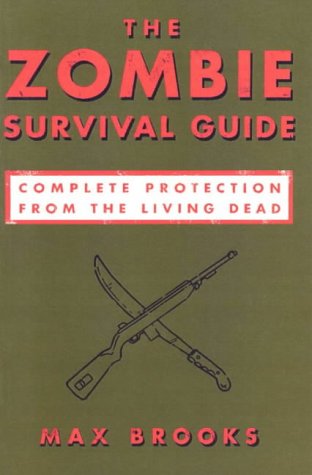
Review: The Zombie Survival Guide by Max Brooks

The Zombie Survival Guide
By Max Brooks

Published: 2003

Synopsis (Goodreads): The Zombie Survival Guide is your key to survival against the hordes of undead who may be stalking you right now. Fully illustrated and exhaustively comprehensive, this book covers everything you need to know, including how to understand zombie physiology and behavior, the most effective defense tactics and weaponry, ways to outfit your home for a long siege, and how to survive and adapt in any territory or terrain.


As some of you may know I'm currently working on a thesis which concentrates on zombies in film, so obviously I'm a bit of a zombie fan! That said I actually picked up this book (out the bookshelf it belongs to Tom) thinking it was Max Brooks' other zombie novel World War Z. Perhaps it was this original confusion which had me ready for an epic zombie narrative that resulted in my, well, boredom when I attempted to read 272 pages of 'non-fiction' zombie survival techniques.

I thought the concept for this book was great, and it was obvious Brooks spent a long time researching and conceptualising the idea, but reading a book about what weapons to take, what buildings will protect you best, and what transport to steer clear of, was fairly dull for me. I was lucky if I could get through more that 15-20 pages at a time, so this book has taken me close to 2 weeks to get through which is longer than I've spent on difficult classics! I did consider just throwing in the towel, several times in fact, but I forced myself to finish it so I could write this review.

It was a similar experience for me as reading Pride and Prejudice and Zombies, the gimmick wore off quickly and I sat there reading it thinking, "why am I wasting my time reading about barricading houses and head shots when I could be reading True Grit or World War Z like I'd intended?" That probably makes it sound worse than it is. Granted, it wasn't my cup of tea, but this sort of dry, educational non-fiction never is. In saying that I do think there would be people who could enjoy this book, you just have to be open to this format of book.

The final chapter somewhat redeemed the experience for me. Quite a bit longer than the others that proceeded it, this chapter was a chronological account of zombie threats and attacks that have happened in the past. Spanning from the earliest account in 60,000 B.C of cave painting depicting a zombie attack (central Africa) to the most recent (at time of publishing) in 2002 of a single zombie in St. Thomas which has spawned a tourist campaign similar to the loch ness monster, the chapter covers attacks from across the globe and is formulated mostly thanks to 'unnamed' informants who were able to take the original files or archived documents from police stations, government agencies and even the Vatican.

I think if these accounts had been dotted through the other chapters more (although there already was the occasional anecdote) I would have found it easier to push through the drier content. The tales in this final chapter were full of conspiracies and government cover-ups and some even wound real historical figures (Alexander the Great makes an appearance) or events into the story, and, while still written in a rather dry manner, were far more interesting and engaging that the rest of the book put together.

While I found it a tough to read through this entire book, I can't actually fault it in terms of writing or ideas. Max Brooks clearly put a lot of time and energy into it and wrote in accordance with the style of book he was trying to create. The only problem is that I would never otherwise think to crack open a survival guide, perhaps even with an actual apocalypse breathing down my neck! I'd only recommend this to people who are interested with the idea of a survival guide, and are happy to read a book devoid of any plot, characters or action sequences.

My rating: 3/5

Tuesday, June 21, 2011

Academic mini-reviews - Zombies!

I asked you guys awhile ago whether you'd be interested in me reviewing the many, many books I'm reading at the moment for uni. The feedback was positive so I decided to go ahead with it. One change though was that I decided I'd only pick the ones that would be interesting to read for people outside of my study area (no dull textbooks!) and I'd only supply mini reviews since I don't feel like they actually need a really in-depth review. So here is my first collection of books up for reviewing. Let me know in the comments if you think this is an effective way to review this type of book or if you'd rather I put in a more detailed analysis of them.


Gospel of the Living Dead by Kim Paffenroth

my rating: 4/5

This book was an incredible look into the deconstruction of Romero's zombie 'Dead' series through a religious lens. Paffenroth's use of theological beliefs and theories in conjunction with zombie depiction provided an interesting and informative glimpse into modern America and commented on several aspects of today's society and religion. Bonus points were given for working Dante into the analysis.


The Book of the Dead by Jamie Russel

My rating: 5/5

A fantastically detailed look at the evolution of the zombie from its Haitian origins up to its most recent cinematic features. Jamie Russell distances himself enough to talk about the movies in terms of their technical and critical successes and favours, rather than simply talking about the ones he enjoyed the most, which I've found many other zombie film critics to do. As a student doing my thesis on zombies in film this book will be indispensable, but it's interesting and entertaining enough to be read by a zombie enthusiast also. Chock full of film reviews and colour pictures of their release posters and film stills too.


The Powers of Horror by Julia Kristeva (translated copy)

My rating: 3.5/5

This is not a zombie book, it's a psychology text that concentrates on the theory of abjection by examining our reaction to dead bodies, castration, the oedipal complex (though discussed in a way I hadn't come across before) and a myriad of other things. It uses theories by Lacan and Freud as a base and builds upon them with Kristeva's own detailed and engrossing theories. The language is remarkably easy to read for someone not from a psychology background however the theory is quite dense and complex and it took me quite awhile to fully appreciate the ideas she was putting forward.


The Cinema of George A. Romero: Knight of the Living Dead By Tony Williams
My rating: 3.5/5

This book examined Romero's film cannon (not simply his zombie films) with a concentration on the link between his work and literary naturalism, which was a lens I hadn't seen used in conjunction with zombies before. While the analysis on some of the films felt lacking and seemed more like a regurgitation of the events of the films, overall it was a comprehensive, unique and interesting view on Romero's style of film-making.


LinkWithin

Related Posts Plugin for WordPress, Blogger...