Showing posts with label drama. Show all posts

Friday, August 15, 2014

6 Degrees of Separation: Gone Girl

Today was the first time I heard about the '6 degrees of separation' meme hosted by Annabel and Emma. I've been looking for some content to help fill my weeks now that the HTBAG readalong is over and this seemed like a fun challenge. The rules are pretty simple too.


So here we go!


Gone Girl was fine. I found myself quite wrapped up in the story as I read it, but the more time that passes the less I think it was really anything substantial. Be that as it may, it's memorable for many things. The relationship between the married couple, the dark twists that abound the narrative and the absolutely horrendous people that populate the cast.

Horrendous people? Surely you're talking about the cast of Jonathan Franzen's The Corrections! I had a brilliant time reading this book with a group of bloggers last year, but ye gods were the people awful. Awful yes, but at least they weren't alone in their awfulness. The family that destroys-your-will-for-life together, stays together.

A better, although no less sinister, family are the sisters (and their poor uncle) in Shirley Jackson's novella We Have Always Lived In The Castle. For two young women they've been through a lot and are well acquainted with the flurry of emotions that follow the death of a family member(s).

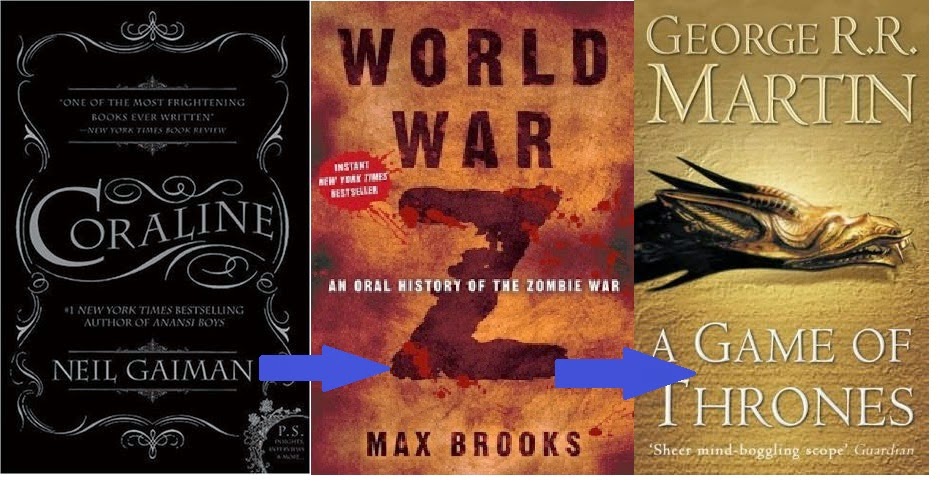
The house in We Have Always Lived In The Castle plays an important role in the narrative. Similarly, the house is Neil Gaiman's novel Coraline has its own special place between the pages. It is rife with magic and hidden passages and old and evil things and presents our Coraline with a novel worth of adventures and scares.

A few years ago Coraline was turned into a cracking good film, and after a couple of years of production delays and arguments between lead actors and directors, World War Z finally made it to the big screen to generally good reviews. The film had nothing on the book though, which managed to tell a terrifying and emotionally charged story about a world succumbing to the onslaught of undead villains. Perhaps the defining feature was the collection of short eye witness accounts that make up the novel. It's these differing perspectives, those of politicians and generals and filmmakers and doctors, that adds a level of humanity to the story that's often absent in zombie and end of world stories.

And finally, also utilising the multiple narrator format is George R. R. Martin's A Game of Thrones. Switching between different lead characters found in various parts of warring Westeros, this series manages to tell dozens of different stories within the larger patchwork narrative.


Thursday, August 14, 2014

Movie Review: These Final Hours (2014)

These Final Hours

Released: 2014

Directed by: Zak Hilditch

Starring: Nathan Philips, Jessica De Gouw, Angourie Rice

Synopsis:  It's the last day on earth, twelve hours before a cataclysmic event will end life as we know it. James makes his way across a lawless and chaotic city to the party to end all parties. Along the way, he somewhat reluctantly saves the life of a little girl named Rose who is desperately searching for her father. Stuck with the unexpected burden of responsibility, James is forced to come to terms with what really matters in life as the final hours tick away. (Via Roadshow and IMDB)

_______________________________________________________________________________________________________

About a month ago Tom and I were watching TV and saw a trailer for a seemingly big-budget Australian end-of-the-world film. If you're American I'm sure you're used to seeing trailers for your films on TV all the time, but Australian films rarely have much screen presence, unless they're a co-production with America (Daybreakers for example). A lot of other countries (especially around Asia) are very nationalistic when it comes to their home cinema but if you ask most Australians they'd say Australian cinema sucks, but that's because we so rarely see it unless we hunt it down. Instead it silently slips into cinemas and only makes a splash when it then makes waves at overseas film festivals. Which is ridiculous because we have some of the best funding schemes for filmmakers in the world, and have some of the best production and VFX companies in the world and yet your average Australian probably could only name The Castle if they were asked to name an Australian film*. But enough of a rant about film consumption and production in Australia, none of you care about that and it has zero to do with this review. Basically, Tom and I were shocked to 1) see a trailer for an Australian film on TV, 2) see that it looked like a big budget blockbuster (rather than the art house or broad comedy that usually gets made here) and 3) that we had heard absolutely nothing about it. While a lot of Australians may not know much about the films made here, we pride ourselves on getting out and seeing a lot of them. So to have never heard of this one was a little mind-boggling.

These Final Hours is basically an end-of-the-world film quite unlike most end-of-the-world films. Where most usually involve scientists or politicians or some honest hard-working American who just wants to keep driving his truck and listening to good ol' country and western music trying to thwart the coming disaster (volcano, meteor, global warming, sharknado), this movie has accepted the fact that we are fucked. We can't send some crack team of astronauts to blow up the meteor or force it to change course, we can't survive the impact and we can't even rest easy knowing that Australia is a million miles from everywhere else on the planet. Instead, because of our relative isolation we end up watching the world die. A radio announcer visits us in voice over at certain parts of the film to let us know that Canada is gone, all of South East Asia, South America. It adds a level of hopelessness that's rarely seen except in post-apocalyptic films (The Road is a perfect example) - what the hell do you do for you final 12 hours when most of the world is already dead? How do you do anything when you know that your death is looming heavily above you and that you can't do anything to change it?

For James (Nathan Philips - Wolf Creek, The Bridge), the answer is to go to one final party and get so hammered that you don't even see or feel the end coming. Others turn to suicide, to looting, to God, to living out the deviant acts that they repressed (or perhaps always did, but did under the cover of night) before they knew the world was over. The first 10 minutes of the film shows James driving through Perth to get to his party and passing over-turned cars, dead people lying on the road, people clutching each other in prayer circles and desperate attempts to survive the impending doom (wrapping the house in aluminium foil - to stop the heat?). James ignores the people calling for help as he drives to his destination, until an altercation with a mad man with a machete forces him to ditch his car and run to find a new one. This is where he finds Rose, a young girl who has been abducted by two of the grossest men you'll ever see. These are the guys who have chosen to live their final hours by ruining the final moments of others. James may be apathetic to the situation at large, but even he can't ignore the cries of a small girl about to be viciously attacked. The rest of the film is part road film, part drama, part thriller and a lot more nuanced than I expected. It's a film of choices. James has to choose between his original plan for oblivion or to help Rose find her father so she can face the end with him. Does he leave her at her dad's car and hope he returns, or does he take her with him? Does he leave her with his sister, or does he take her to her aunt's? How exactly does he want to end his life and does it even matter? All the while the end of the world is creeping closer.

This movie, especially the opening 10-20 minutes made me think of the film The Purge. The Purge is incredibly lopsided and while the basic conceit is interesting (one night where crime is legal a year) it is handled really poorly. You just cannot make me believe that people who are so happy to go out and murder and rape would be willing to hold off for 364 days of the year. Nor can you make me believe that the effects of this free for all, vandalism and looting and the destruction of homes and businesses doesn't cripple local economies. Unlike The Purge, These Final Hours places that basic concept into a more believable setting. Are people necessarily going on murder sprees? No, but when you know the world is ending and you life has a very clear expiration date your emotions would be boiling over. Would you maybe go to far when you fight with someone over a petrol pump? Maybe someone throws a bottle at you and you react instinctively, releasing all of your frustration and fears as you punch the person over and over. Rather than have people just randomly moving past the moral taboo of murder without a second thought, you show the very likely events that transpire when people are being ruled by fear and fuelled by alcohol or drugs or whatever they choose to use to cope with the world crumbling around them. It's raw and ugly and depressing as hell, but it made for a compelling film.

From the trailer (placed at the end of the review for anyone interested) I hadn't expected this film to be as Australian as it was. But despite the bells and whistles it's still as depressing as all Australian drama. I mean, if you find The Road depressing, welcome to Australian cinema. We defined the concept of bleak and our landscape helps reinforce that. It's desolate and sparse and if you expect anyone to be alive at the end of an Australian drama... ha ha you're cute. But they always manage to raise some intriguing ideas and questions, usually unique to Australia. Isolation is a common theme in Australian films because we are a very isolated country. We're cut of from the rest of the world by oceans and we're cut off from each other by distance. People aren't lying when they joke about their nearest neighbour being 5 kilometres away. If you aren't in a Capital city, you're surrounding by a whole lot of space and not a lot else. So the fact that this film takes that inherent truth of our national identity, that we're alone, and magnifies it so we literally become the last people left on the planet hits incredibly hard. Can you think of anything that would make you shut down faster than knowing every other country, every island, every person on the planet is gone?

These Final Hours is written and directed by a relative newcomer and is remarkably tight considering that. There are a few hiccups with pacing and some of the dialogue but for the most part the film is a remarkably sombre and thought-provoking thriller** with some absolutely gorgeous cinematography. I have no idea if or when this film will be released overseas, but if you get the chance I'd highly recommend giving it a watch.


If you want to know a little more, the interactive website is really well made and definitely worth a visit. It adds a little context to the film's setting as well, which isn't crucial to viewing the film but definitely adds some extra dimension.

*So if an Australian tells you there aren't any good Aussie films slap them in the face and tell them to do their homework. I could give them a list of 50 films off the top of my head that are made in Australia and shit all over anything else made worldwide. 

**Is it a thriller? That's how it's classified on IMDB but I think it actually falls closer to drama.

Tuesday, July 24, 2012

Review: The Road by Cormac McCarthy

The Road
Written by Cormac McCarthy

Published in: 2006

Synopsis: A father and his young son walk alone through burned America, heading slowly for the coast. Nothing moves in the ravaged landscape save the ash on the wind. They have nothing but a pistol to defend themselves against the men who stalk the road, the clothes they are wearing, a cart of scavenged food--and each other.

(Jesus, how fantastic are these typography covers he has? I know you aren't supposed to judge a book by its cover, but I'd like to marry this cover and make beautiful typographic babies with it.)
_____________________________________________________________________________________

If this book were a colour, it would be grey. If it were a word, it would be bleak. If it were a sound it'd be white noise or the persistent drip, drip, drip of a leaky faucet. This isn't a cheery book. If you're even slightly bummed it will make you 1000 times worse, guaranteed. Yet it's an incredible and captivating book. I had no idea if I was going to enjoy this book, and to be honest I wasn't particularly eager to read it. Something about the crazy praise McCarthy has received from every possible critic just made me feel like he perhaps was being built up as something he could never possibly be. As much as I enjoyed The Road, until I've read a few more of his books I'm weary to jump onto the McCarthy bandwagon (I still dislike the author himself - or at least the pettiness he seems to view readers with), however he's at least partially proved those critics right with this fine, fine piece of Literature (yes, with the capital L).

And this is where I run into some trouble, I'm finding it hard to describe what it is I loved about this book, and why I consider it a success. For all intents and purposes this kind of Capital L writing is not my thing. Usually I find it a little wanky and pretentious, and I find it pretty lazy since they usually spend more time trying to craft the "perfect" sentence rather than develop a decent story or character. Certainly The Road is full of Capital L writing, some of which made me giggle it was so over the top, but mostly it just felt right. Same with the characters. They're nameless and are only referred to as The Man and The Boy (or something similar), and there is little in the way of a past developed for them. Similarly, considering the entire story takes place as they walk along a road in a dystopian America with very little happening, there are few instances where you get a really clear idea of their personalities, motivations or idiosyncrasies. However this doesn't bother me, because in the context of this story all you need to know is that they're continuing on. They keep moving and moving because they don't know what else to do, and The Man, perhaps selfishly, keeps his young son alive and starving in this poisonous world because he loves him too much to think of a world without him.

I guess it's the simplicity of this concept at the heart of this novel that I loved. It was a father's unconditional, earth-moving love of his son (who he refers to as a god several times) that motivates every event and non-event that forms this book, and that's kinda beautiful. Or maybe their defined idea of right and wrong, even in the face of complete destruction and catastrophe, speaks to the romantic in me. They're the good guys, the ones who carry the fire, who would rather stave than kill another human for food. Perhaps in reality we'd all turn to cannibalism, but I'd like to think that's a line I'd never cross, at least if it meant killing a person (especially a child or baby). In fact, I think that pretty much sums up the two primary points why I loved this book, and why, amidst the Capital L writing, lack of punctuation and sparse, sometimes ridiculous dialogue (the conversation between The Man and an Old Man On The Road was the only thing I actively disliked in the whole book) I still love this book more than many others I've read this year. Or maybe it's something else, maybe I should stop searching for the reason and just accept that this novel effected me in a completely visceral level, and no amount of discussion will uncover any real answers.

Also, one thing before I end this terrible review. How in the hell did they get the green light to adapt this book to film?! I mean that in the best possible way. Normally a book will be twisted and abused until it better represents the ideal Hollywood blockbuster (case in point: I Am Legend )but not this one. The film is just as quiet and bleak and full of nothingness (and yet everythingness) as the book and I'm astounded that no one tried to add at least one huge action sequence or flashback to the end of the world. Regardless of if you like the book or not, all of you bibliophiles must surely recognise the amazability of this! (yes I'm full of fake, made up words in this review!)

The Road is a minimalist novel filled with bleaker than bleak imagery and events and it won't be for everyone, and I imagine you probably have to be in a rather exact mind-frame to be able to accept it, but perhaps you will find yourself loving the book as much as I do. I don't know if I'll ever re-read this one, I don't imagine it'll ever become one of my "read once a year" books, but I really, really, really loved this book. It's just...unexplainable.

Saturday, April 28, 2012

Film Review: Take Shelter (2011)

Take Shelter

Directed by: Jeff Nichols

Starring: Michael Shannon
Jessica Chastain
Shae Whigham

Synopsis: Plagued by a series of apocalyptic visions, a young husband and father questions whether to shelter his family from a coming storm, or from himself.

I follow a film Tumblr called Old Films Flicker who I rely on for decent movie recommendations both old and new. A little while ago she went crazy with screen shots and odes to Take Shelter, starring the enigmatic and unbelievably talented Michael Shannon. It's a fairly small film, and while it seemed to open to positive reviews in the US it never opened in cinemas here in Australia, so I added it to my film queue to watch on DVD.

Other than the screen shots and quotes Old Films Flicker posted, I had no real idea what this film was about. I knew that Michael Shannon's character (Curtis) was seeing visions of the apocalypse and a huge storm, but I wasn't aware of the genre so I had no idea if it was going to be a drama, and action-drama or a thriller. This probably could have been disastrous if I hadn't been in the right mood going into it, the film is very slow and at its heart is a family drama of monumental proportions.

Curtis is a small town husband and father who works on a drilling crew by day, and spends time at home with his wife, Samantha, (Chastain) and daughter, Hannah, at night. When Curtis begins to suffer from frequent dreams and hallucinations of a humungous storm with apocalyptic after-effects, their simple life is rocked in its foundations. Fearing mental illness Curtis secretly visits a counsellor and seeks medication, but as the dreams worsen and he develops and obsession with renovating their storm shelter, his family and friends begin to fear (for) him. What follows is a slow descent into madness, paranoia, obsession and fear as Curtis' visions become more frequent, while the question "what if..." is always present, lingering just off to the side, partly out of view.

Is he crazy? Are his visions real? Is he going to snap and murder everyone in their town? Until the end credits roll you will never be 100% sure which way this film is going to go. While it is primarily a family drama about a husband who is suffering from these visions, it never lets go of the possibility for a supernatural inclusion, or for a dark devastating turn that'll mess up your sleep for a week. This fervent questioning plays an important role when you consider how slow the film moves. The film revels in forcing you to just sit and watch as this family is pulled apart by mental illness. There are minimal edits and instead you watch an entire conversation, in all its awkwardness or sadness or distress. The characters progress through the entire gamut of emotion that would occur in a normal fight or moment, there are no easy resolutions, no simple answers. And while this results in a slower pacing that I typically enjoy, I respect the hell out of it.

Going hand in hand with the pacing is the visuals in this film. It's hard to find a film these days that isn't visually beautiful (especially films of the indie persuasion) but the beauty of this films wideshot small town aesthetics is emphasised because it is juxtaposed against the claustrophobic storm shelter and Curtis's dark descent into madness and swirling storm clouds. The effect this produces is astounding and one of the biggest draws in this film. My favourite is most definitely the shots with the birds swirling around the sky in apocalyptic formation (see promo image above), especially towards the closing of the film. It's just so good!

And the acting, man oh man! Michael Shannon is a phenomenal and completely under-rated actor who is superb in this role. Known best for his roles in Boardwalk Empire and Revolutionary Road, Michael Shannon really embraced the character's quiet and unassuming nature and it is both terrifying and heart-breaking to watch him circle the drain and give in to his paranoia and fear. Jessica Chastain gives a beautifully nuanced performance as his worried wife, Samantha. By the way, where did Jessica Chastain come from?! She has delivered some of the best performances in the best films of 2011, and I had never heard of her before! Hopefully she keeps it up because she won my heart in this role. She's so fragile, yet so strong. She's taken on the task of learning sign language so she can communicate with her deaf daughter, and she sells handicrafts on the weekend so that the family can spend one week a year at the beach. She's the glue that holds the family together, but as Curtis falls apart and recedes further into himself, she doesn't have enough fingers to plug the holes that are threatening to burst.

So all in all a terrific film! It manages to balance between a couple of genres yet never lose sight of the characters and their own problems, rather than focussing purely on these apocalyptic visions Curtis sees. I do have to warn you all how slow the pacing is, but if you can handle it then definitely find a copy of this film to watch.


LinkWithin

Related Posts Plugin for WordPress, Blogger...