Showing posts with label historical fiction. Show all posts

Wednesday, July 15, 2015

Book Review: The Lady of the Rivers by Philippa Gregory

The Lady of the Rivers (The Cousin's War #3)

Written by: Philippa Gregory

Published: 2011

Synopsis: Jacquetta, daughter of the Count of Luxembourg and kinswoman to half the royalty of Europe, was married to the great Englishman John, Duke of Bedford, uncle to Henry VI. Widowed at the age of 19, she took the extraordinary risk of marrying a gentleman of her household for love, and then carved out a new life for herself. (via Goodreads)


*mild spoilers below, but really, it's based on a historical event so this shouldn't be news to you*

____________________________________________________________________________________________________________

“Any woman who dares to make her own destiny will always put herself in danger.”


I don't tend to read it too often, but I really do love historical fiction. There's something about reading a fictionalised account of a family or event from long ago which just ticks a lot of boxes for me. The Lady of the Rivers is actually the third in Philippa Gregory's Cousin's War series, but it's a prequel that takes place during the years prior to and during Henry VI rule. It focuses on Jacquetta, a real life fascinating woman, who began her life in English-occupied France, the daughter and niece of Luxembourg royalty (and a Goddess), before marrying one of the most powerful men in England, John of Lancaster.

Jacquetta is a perfect character for this type of book because while she's involved in a lot of the critical events that led up to the Cousin's war, she's removed enough that the book isn't just another rehash of a very famous family feud. Instead we see life on the outskirts, how her first husband ruled France and how he tried to guide his young nephew, the king. We see the early days of Henry's rule and the follies of youth as he and his young wife play favourites in court and have zero understanding of how to run a castle, let alone a country. And we get a little insight into raising a child (or 14 as is the case with Jacquetta) during these tough and troubled times, especially as a lady of the court who is forced to spend months away from their children. This peripheral view, I imagine since I haven't read the following two books, also helps to set the scene quite well for the really character-driven narrative that is to come*.

One of the best things about this book was how focused it was on women in this era. Through Jacquetta and the women in her life, we see how few options they had. And not only did they have far fewer options in life compared to men, but their futures were largely out of their control. If they were from wealthy families like Jacquetta, their marriages were often to form alliances or to solve land feuds. Jaquetta's first marriage to John of Lancaster is never consumated, instead she is an object for him to use. Jacquetta, as their family myth says, is gifted with the "sight" because their oldest ancestor was the water goddess Melusina. John, obsessed with alchemy, wants Jacquetta to see the future in a mirror and help him guide his nephew to success and prosperity. And while her talents puts her in his favour, as the reader sees with Jacquetta's brief interaction with Joan of Arc and another woman of the English court, this favour can quickly turn sour when it no longer works in someone's favour. A talent at forecasting the future or making herbal remedies quickly becomes signs of witchcraft and can lead to an unfortunate end tied to a stake. In a less supernatural sense, a woman failing to give her husband a child and heir just as quickly turns from favour. It was a time where women were balancing on a tightwire, hoping to keep their husband, their father, their brother, and their King happy.

In spite of this, Jacquetta, and several other women in the book, are shown to be independent and strong characters. They make themselves heard and they make their own choices, even though they face dire consequences. After John's death, Jacquetta marries his squire and almost loses everything in the process. But her marriage is one of love, and not only do they survive, they rise high in the court. Henry's wife and Queen, Margaret, is ruled by her emotions and is a passionate and fiery woman. Many of her decisions could have risked her her crown and her head, but she lives as she pleases regardless. Joan of Arc, although only in the book for a short while, is an absolutely beautiful and principled girl. Her trial and death is utterly heartbreaking, and the weight of it effects Jacquetta long after it happens. The women are the focus of this book, so we see a lot less of the wars and fighting than many books that deal with this era typically show. This I am eternally grateful for because, ugh, I don't need more battle scenes in my life. I get enough of them in Game of Thrones thank you very much.

Now this isn't to say this book is perfect. It falls into many of the holes historical fiction struggle to deal with. There is an insane overuse of titles in the book. Every time John is mentioned, it is "John of Lancaster, first Duke of Bedford". While I know it's hard to keep on top of all the characters, especially since they all seem to be called John, Richard, Edward and Henry, but when you have a 10 page chapter that only involves a discussion between Jacquetta and her husband, I think the reader can be trusted to understand which John this is. It also struggles at times with covering so much. I loved that it gave glimpses into life in court, away from court, during pregnancy, during birth, during war etc etc, but this did mean that sometimes things were fairly shallow in their depiction. A few times Jacquetta brings up her pregnancy and then gives birth 200 words later and then you don't hear of the child for another 40 pages. A tightening of the focus, just a bit, may have helped here. Building on this...I hated Margaret. She was an insipid and obnoxious brat who plunged two countries into ruin because she wanted to play favourites at court and didn't have a proper grasp of money or time. Because the book is so focused towards the women in the narrative, all of the blame ends up heaped on her shoulders, probably unfairly, while Henry is barely discussed or depicted as a pious and naive young man. Because Jacquetta is one of her ladies in waiting, we spend so much time with her, especially as the country falls into war between the two factions of the family. I didn't like spending so much time with her scheming, although I guess there wasn't a lot else that could be depicted since we were following Jacquetta. But to further infuriate me, the book depicts Margaret as this horrendous woman but then Jacquetta will dote on her or excuses her terrible actions. I couldn't get a read on how Jacquetta truly felt. When she talks about a shallow or dangerous decision made by Henry and Margaret, is she simply being nice because it's her job to be loyal, or does she truly not understand/care how terrible that decision was? Jacquetta was shown to be so intelligent before this part of her life, and suddenly I couldn't tell if she was playing it safe or naive or foolish or simply blind. At the end of the book I was firmly on the York side, which I don't think was Gregory's intention.

Problems aside, I did really enjoy reading this book. I spent most of my first day up the Coast with Tom with this book in one hand, and my phone in the other googling names so I could work out everyone's relationship. English family trees give me such a headache! I loved that this book introduced me to a new badass woman in history. Because Jacquetta most definitely was a badass. This book sadly doesn't cover the later years of her life, but she ends up accused of witchcraft (hence the supernatural elements threaded through this book) and manages to escape with her life. And as a mother of 14** it's really beautiful to see how much she fought for her kids and for them to have the best in life. Other accounts of Jacquetta that I've read since tend to depict her as this grabby power-hungry woman who used her children to rise up in station, and maybe she truly was the 15th century version of Kris Kardashian but I much prefer this version. She fought for and risked everything for all of the people in her life, even those like Margaret who perhaps didn't deserve her love and loyalty. Melusina would have been proud.


*Like I said in the intro, this is actually the third in the series and a prequel, but from what I've read about the other two books it does sound like they are more tightly written in terms of focus. 

**I really should fact check this, it's either 12 or 14, but I've already sent the book back to the library and I'm LAZY.

Thursday, January 8, 2015

Book review: Outlander: Cross Stitch by Diana Gabaldon

Outlander: Cross Stitch (1)

Written by: Diana Gabaldon

Published: 1991

Synopsis: The year is 1945. Claire Randall, a former combat nurse, is just back from the war and reunited with her husband on a second honeymoon when she walks through a standing stone in one of the ancient circles that dot the British Isles. Suddenly she is a Sassenach—an “outlander”—in a Scotland torn by war and raiding border clans in the year of Our Lord...1743.

Hurled back in time by forces she cannot understand, Claire is catapulted into the intrigues of lairds and spies that may threaten her life, and shatter her heart. For here James Fraser, a gallant young Scots warrior, shows her a love so absolute that Claire becomes a woman torn between fidelity and desire—and between two vastly different men in two irreconcilable lives. (Via Goodreads)
________________________________________________________________________________________________________________

A hedgehog? And just how does a hedgehog make love?" he demanded.

I'd like to say there was a valid reason I decided to finally give in and read Outlander. Maybe because I'd heard such great reviews from people like Sarah, or I wanted to read it before I gave the TV show a watch. But honestly, I 100% only read it for the promise of sexy Scottish fellas in kilts. And sexy Scottish fellas in kilts were delivered in droves. Actually, the title of sexy Scot is really reserved for the sexy Scot of the novel - Jamie Fraser. Tall, strong and with hair the colour of fire.

Pictured: TV depiction of sexiest Scot* does not live up to my imagination
I imagine your interest in this book hinges on whether or not you warm to Jamie as a character because if he isn't on the page doing something, the characters present are talking about him or lusting after him. Honestly, in the context of the book he's the greatest thing since sliced bread and it gets pretty funny to see how far people are willing to go to get close to him. I'm looking directly at you here Laoghaire. He's perhaps the most romanticised person I've encountered in a book since Edward Cullen. And while I enjoy Jamie a whole lot more than Sparkle-butt, everyone's obsession with the outlaw is also kind of baffling. He's treated with a reverence and a fear that I don't think he ever really lives up to - but I guess when your life is filled with murderous outlaws and sadistic Redcoats it's easy for a nice guy to be built up to mythic standards. Also, romance.

Claire is another character that I think you either love or hate. I really love that Galbadon chose the end of WWII as the launching place for the novel because it was a time when women were finding themselves reverted once again to second class citizens in the wake of the returning male population. After helping build bombs and aircraft and serving as nurses on the battlefront, women weren't content with just being secretaries or housewives. Claire herself is struggling to find a hobby now that her career as a nurse is effectively over and this causes even more problems when she finds herself 200 years in the past where women are seen as being fit for even less. If this novel had taken place 20 years earlier or later I don't think Claire would have been nearly as combative as she was when she tried to adjust to 18th century Scottish life. That being said, she does a remarkable job blending in with the Gaelic speaking masses. If I were to find myself in her position, I'm pretty sure I would have been burnt at the stake the second I called Jamie bae or whipped out my smart phone. And if I wasn't I would have died of hunger almost immediately since I know nothing about plants or nursing or life in the Scottish highlands.

The novel is a little long. I think it could have benefited from a heavy edit to get rid of a couple of the  barely described sex scenes or slimmed down some of Claire's trips to the garden to pick herbs. I get it, they used a lot of herbs in their medicine back then and Claire knew all their Latin names. I don't care how big her basket is, please take me back to a scene with Geillis (who is totally Stevie Nicks) or Dougal, who I had way too big a crush on. Apparently Dougal in the TV show looks like this:


Which squashes any hope of me bothering with the TV show at all**. I was imagining him more like a Scottish Javier Bardem, which makes sense because this is a ROMANCE.

Length be damned though, this book was fun. I revelled in the castle drama and Claire's temper tantrums. The scenes at Wentworth Prison shifted from horrific to hilarious and even though something like that should be completely jarring, in this book it works.  The book is campy and inconsistent with its fantasy, but Gabaldon is also a fantastic writer - which if I'm being honest I wasn't really expecting. I'm not entirely convinced I want to keep going with the series straight away (they're so freaking huge and I'm still recovering from finishing GOT three years ago) but they're now well and truly on my radar.


*I haven't watched the TV show but seriously, this is Jamie? Ugh, I was imagining Scottish Charlie Weasley and this guy is no Charlie Weasley. (maybe it's just this picture but he looks very Theon Greyjoy-y and ewwww). 

**I'm sorry Graham McTavish. You were great in Red Dwarf but you are not *my* Dougal.

Saturday, January 3, 2015

2015 Reading Resolutions - Diversifying my TBR

Okay, remember when I said I didn't have any reading resolutions and that making fixed plans probably wouldn't work out how I wanted them to? Well I decided to throw caution to the wind and write up a post of books that I want to read that will help me diversify my regular reading status quo. I'm trying to make up this list with books I already have in my possession since I really, really need to stop spending so much money on books I don't read for several years after purchase and the rest I'm going to endeavour to get from my library.

My aim isn't necessarily to read all of these books, although I'm hoping that by writing out such a long list I will be "in the mood" for at least one of these books per month. That way if I'm having an especially white/middle class/American/male month, at least I'm getting a little variety in my diet. The idea isn't that these are the only POC/female/non-fiction reads I'm interested in nor are they the only ones I'll read all year. I might end up reading very few of these particular books but still bring up my end of year stats with other books that I discover throughout the year. Basically, I'm hoping that by listing out some diverse reading options here I'll be able to switch something on in my brain that will subconsciously lead to me picking up more of these types of books.

As for the types of books on this list, I'm aiming for more non-fiction, more female writers and more non-American and POC US writers. Ideally those non-American writers won't simply be Australian/English/Canadian authors, but let's not shoot for Pluto when we haven't yet walked on the Moon. And as you'll see from the list, technically some of these books fulfil two or three of the criteria which is just an awesome bonus.


The Anatomy of Motive by John Douglas

The Secret History of Wonder Woman by Jill Lepore

Bad Feminist by Roxanne Gay

House of Psychotic Women: An Autobiographical Topography of Female Neurosis in Horror and Exploitation Films by Kier-La Janisse

Stiff: The Curious Lives of Human Cadavers by Mary Roach

The Supergirls: Fashion, Feminism, Fantasy and the history of comic book heroines by Mike Madrid

Them: Adventures with Extremists by Jon Ronson

As You Wish: Inconceivable Tales from the Making of The Princess Bride by Cary Ewles

Superheroes!: Capes, Cowls, and the Creation of Comic Book Culture by Laurence Maslon, Michael Kantor

Severed: A History of Heads Lost and Heads Found by Frances Larson

Nobody Knows My Name by James Baldwin


Dear Life by Alice Munroe

The Left Hand of Darkness by Ursula Le Guin

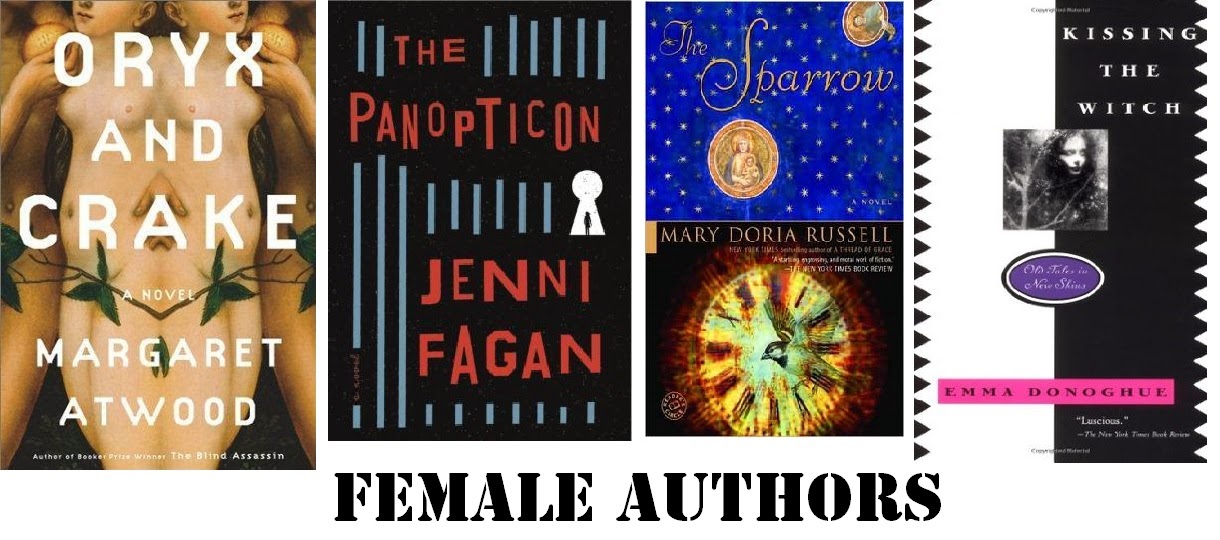
The Sparrow by Mary Doria Russell

Kissing the Witch by Emma Donoghue

Oryx and Crake by Margaret Atwood

Mr Fox by Helen Oyeyemi

Bringing up the Bodies by Hilary Mantel

Panopticon by Jenni Fagen

The Night Gwen Stacy Died by Sarah Bruni


Colorless Tsukuru Tazaki and His Years of Pilgrimage by Haruki Murakami

Balzac and the Little Chinese Seamstress by Dai Sijie

In the Skin of a Lion by Michael Odaatje

Under the Skin by Michel Faber

The Returned by Jason Mott

We by Yevgeny Zamytin

Popular Hits of the Showa Era by Ryu Murakami

Battle Royale by Koushun Takami

Thursday, December 19, 2013

Book Review: Tipping the Velvet by Sarah Waters

Tipping the Velvet

Written by: Sarah Waters

Published in: 1998

Synopsis:  this delicious, steamy debut novel chronicles the adventures of Nan King, who begins life as an oyster girl in the provincial seaside town of Whitstable and whose fortunes are forever changed when she falls in love with a cross-dressing music-hall singer named Miss Kitty Butler.

When Kitty is called up to London for an engagement on "Grease Paint Avenue," Nan follows as her dresser and secret lover, and, soon after, dons trousers herself and joins the act. In time, Kitty breaks her heart, and Nan assumes the guise of butch roue to commence her own thrilling and varied sexual education - a sort of Moll Flanders in drag - finally finding friendship and true love in the most unexpected places.

Challenges: LGBT for Book'd Out's Eclectic Reader Challenge
________________________________________________________________________________________________

“Being in love, you know... it's not like having a canary, in a cage. When you lose one sweetheart, you can't just go out and get another to replace her.”


I started reading this months and months ago after Alice gave me the longest list of Lesbian Lit ever written and this was the only book from that list in my library. But even though I was enjoying it I took ages to get anywhere with it (I blame the chapter length, they make stopping and starting ridiculously difficult) and eventually had to take it back to the library unfinished. I then, for whatever reason, took about two months to finally borrow it out again. But eventually, EVENTUALLY, I managed to finish my first Sarah Waters and now feel very up to date with the lesbian goings on in Victorian London.

This book is about two things and the two things rather inform one another. Firstly, the book is about Nan(cy) - Whitstable oyster girl turned stage performer turned rent boy, turned sex slave, turned housekeeper - and secondly, the book is about the various types of lesbian relationships during the Victorian era. As Nan navigates London and the careers and lifestyles unique to it, we navigate the same path, if Nan is in the dark then so are we. We remain unaware of exactly how extensive the lesbian or "tom" lifestyle is in London until Nan learns such things, and while she throws herself into aspects of the lifestyle (which we'll get to) she remains pretty naive until the final third of the book.

The book is broken up into three sections, and as this is something of a coming of age novel, they loosely map the critical moments in Nan's young adulthood. When we meet her she's on the typical Whitstable career path for Victorian females. She's got a sweetheart, she works in her parent's oyster shop and she'll probably be married and pregnant within a year or two. A trip to the theatre changes this when she witnesses Kitty Butler on the stage, cross-dressing and performing as a male. Nan is immediately drawn to Kitty and after spending night after night at the theatre she finally begins a conversation with Kitty and eventually becomes her dresser and then her performing partner in London. This section is all very sweet and awkward and full of blushing and stolen glances, and when Kitty and Nan finally start a relationship it's wonderful.
“We fitted together like the two halves of an oyster-shell. I was Narcissus, embracing the pond in which I was about to drown. However much we had to hide our love, however guarded we had to be about our pleasure, I could not long be miserable about a thing so very sweet. Nor, in my gladness, could I quite believe that anybody would be anything but happy for me if only they knew.”
But, alas, things quickly sour when Nan realises that Kitty is terrified of people finding out the truth of their wicked and naughty ways and ultimately breaks Nan's heart. After Nan runs from Kitty she becomes a rent boy (no need to expand on that) before finally becoming a sex slave for Diana. This section is filthy! I mean, this shouldn't come as a surprise since I described Nan as a sex slave, but woah, Waters does not hold back with the scenes between Nan and Diana. And I'm not exaggerating when I call her a sex slave, because that's exactly what she is. She's "paid" in new clothes and accessories but she has no life of her own. Her movements are resticted, she can't leave the property and she's treated like a performing animal at Diana's parties.
"My dear, I have said: you should have pleasure for your wages! You should live with me here, and enjoy my privileges. You should eat from my table, and ride in my brougham, and wear the clothes I will pick out for you - and remove them, too, when I should ask it. You should be what the sensational novels call kept"
The second section, torrid sex scenes aside, is also kind of heart breaking. Though Nan seems to accept that her sexuality isn't something she can change, she also seems to have resigned herself to see it through Kitty's eyes. So while there are elements of self-empowerment and pleasure in choosing to be kept by Diana, it also seems like Nan is punishing herself for her proclivities. It's as though she believes that lesbians can't have a regular love life and since her sister and Kitty see it as something to be ashamed of she'll prove just how extreme it can be, whether it's actually what she wants or not.

The third and final section is probably my favourite of the three. After living a pretty rough 5 years, Nan is left with nowhere to turn. Luckily she finds Flo who is perhaps one of the loveliest characters to ever be written. After 18 months being spoilt and abused, life in the working class comes as something of a shock to Nan, but she quickly gets used to cleaning house and looking after little baby Cyril. It's in this section that Nan realises life as a lesbian isn't all secrets and sex slavery, and that she's not as unique as she thought. This section is about stability, growth and perspective and it's wonderful to watch Nan navigate her way around.

The book is very well written. Sarah Waters has a gorgeous way with words, bringing life to Victorian London and the excitement of the theatre and the complexities of a lifestyle looked down upon at the time. Though as much as I loved the characters and the actual narrative, I could have happily read 300+ pages of Sarah Waters describing the sights and sounds of Victorian London and the surrounding towns.
"Like our oyster-house, it had its own particular scent - the scent, I know now, of music halls everywhere - the scent of wood and grease-paint and spilling beer, of gas and of tobacco and of hair-oil, all combined. It was a scent which as a girl I loved uncritically; later I heard it described, by theatre managers and artistes, as the smell of laughter, the very odour of applause"


Tuesday, November 20, 2012

Review: Wolf Hall by Hilary Mantel

Wolf Hall

Written by: Hilary Mantel

Published: 2009

Synopsis: England, the 1520s. Henry VIII is on the throne, but has no heir. Cardinal Wolsey is his chief advisor, charged with securing the divorce the Pope refuses to grant. Into this atmosphere of distrust and need comes Thomas Cromwell, first as Wolsey's clerk, and later his successor. Cromwell is a wholly original man: the son of a brutal blacksmith, a political genius, a briber, a charmer, a bully, a man with a delicate and deadly expertise in manipulating people and events.

Ruthless in pursuit of his own interests, he is as ambitious in his wider politics as he is for himself. His reforming agenda is carried out in the grip of a self-interested parliament and a king who fluctuates between romantic passions and murderous rages.
_________________________________________________________________________________

A month or so ago I listed Wolf Hall on my Top 10 Tuesday books-I-should-read-but-holy-shit-they-terrify-me-and-i-just-don't-think-I-can-do-it list. A few weeks later I decided to man up and get a forklift to carry the book down off my bookcase and crack open the cover. And what happened? Well, once again I realised how ridiculous it is to let size or content scare you away, because it is almost always an AMAZING book that you're missing out on.

Like every book to every be written about England in the 16th century, Wolf Hall deals with the soap-opera that is King Henry VIII, but unlike the others that came before, that's really peripheral action. What this book is truly about is Thomas Cromwell, a man few people have more of a shadow of knowledge about. Typically he is reduced to an over-the-top villain, someone who manipulated and ployed and took pleasure destroying the lives and families of people he opposed. But who really believes that? How often do you come across a person who is wholly good or wholly evil, especially in history? This book takes you back to the start, right back to when Cromwell was a small boy with a penchant for fights, and tries to unravel the mystery wrapped in an enigma that is Thomas Cromwell.

Now, this isn't to say that Henry and his lovely (*cough, cough*) wife Anne don't feature heavily in this book. They do and they must, considering how intricately entwined Cromwell and Anne's rise to favour is. But it purposely shies away from just being another tell all tale, and dissects how much both the King and Anne grew to rely on Cromwell, even while he was still just a clerk for Cardinal Wolsey. Further, the relationship between Anne and Henry, which for all accounts seems to have consistently been unstable at best, mirrors the instability of Cromwell's career (and anyone else's I suppose). It was so easy to fall out of favour with the king, as we saw with Wolsey when he was unable to secure a church sanctioned divorce, or More when he refused to accept the switch in church head. The King was able to lift you to great heights, with him you could transform from blacksmith's son to King's chief of council or from lady to Queen, but if you fail to give him whatever it is he desires, sons, loyalty, money, youth...well, let's just hope you aren't too fond of your neck.

Moving away from Henry and Anne though, this book (I think anyway) does a stellar job filling the blanks and creating a man who isn't simply two-dimensional but is full of contradictions, and ill-made decisions, and pride and folly and a love for small dogs he calls Bella; all of those good and not so good things that make us human. Whether it's factually correct I don't know, although I know Mantel is a stickler for research, but I'm more than happy to allow for some creative allowances in order to open up a character who was always so private. One of the real beauties of this book, is that we're shown several sides of Cromwell. There's the merchant, the lawyer, the mentor, the lowly born man rising through the ranks, the confidant, the husband and father who loves his family more than the world;
"She almost never sees him; why is he here? But she trusts him and lets him lift her, without protest, into his arms. Against his shoulder she tumbles at once into sleep, her arms flung around his neck, the crown of her head tucked beneath his chin"
But what I loved most about him, in the book anyway, is how preoccupied with his past he is and how others perceive him. Sure, he hides it well, but there's a seething rage barely contained any time anyone mentions his early life as the son of a blacksmith (or one of the many rumours circulating about him) and a barely covered glee when one such person gets knocked down a peg or two. He tries to be a gentleman, mostly for the advantage of his son and wards, but he can't escape his past as a angry and violent young man, and after overhearing a young musician describe him as having the face of a murderer he returns to this description at times of low self-esteem.
"I see how you would look like a lawyer. Not like a murderer, no. But if you will forgive me, master, you always looks like a man who knows how to cut up a carcase"
 When I first sat down and started reading this book I was a little dismayed. I found the style confronting, most likely because it has quite a modern bent but also for the first chapter or two the narration is quite removed from the action (almost like recounting a dream) so I felt so peripheral to the story and unable to get a decent hold on it. Luckily, this style settles down a bit during the guts of the story which takes place between 1520-1535. Or maybe I just got used to it. One thing that did consistently trip me up was Mantel's use of 'he' as interchangable with 'Cromwell' but then also using is as a personal pronoun to describe other people. It means having to re-read sections to work out if 'he' is Cromwell, or perhaps More, or King Henry, or Cromwell's son, or the pope or...well you get the picture. Also, and this isn't the fault of Mantel, why must everyone be called Thomas, Mary and Henry. Seriously, there are maybe four characters who don't share these first names. And when Mantel then goes on to introduce a character as Thomas More, then just Thomas, then he or Duke of Windsor (which I know More wasn't, but EXAMPLES) all in the space for half a page...well, confusion reigned.

But anyway,  I really, really liked this monster of a book and can't wait to get my hands on the sequel Bring in the Bodies. If you don't like historical fiction, I doubt this one is for you, since part of the attraction is seeing the events of that era through fresh eyes and delving into a well-known, but little understood character. But who knows, the strength of the writing style, characterisation and content (there's a fair bit about life, tradition and relationships in the 16th century) might be enough to pull you over into our side (team historical fiction!). For those of you who do like historical fiction, this is a fresh, interesting and captivating look at a subject that I usually view as equal measures tiring (another tv series/movie/book? Really?) and intriguing. And if you don't come out the other side kinda loving Cromwell then you clearly read the wrong book!

LinkWithin

Related Posts Plugin for WordPress, Blogger...